
CLÉMENCE POUGUÉ BIYONG
Clémence Pougué Biyong

About

I am an economist with expertise in impact evaluations of public policies and innovative interventions advancing women’s economic empowerment. My work focuses on how both formal norms, embedded in laws and policies, and social norms, embedded in behaviours and institutions, unlock women’s human capital and shape women’s economic opportunities.

Since 2023, I have been working at the World Bank, within the Africa Gender Innovation Lab, where I evaluate and scale interventions strengthening women’s access to assets, financial services, labour market.

Since September 2025, I am leading a new joint research agenda between Women, Business and the Law and the Africa Gender Innovation Lab, bridging legal analysis and impact evaluation to inform regulatory reform, implementation, and enforcement.

I received my PhD in Economics from the University of Paris 1 Panthéon-Sorbonne and a Master’s degree in Law from the École Normale Supérieure.

Research

Research interests
Impact evaluation Gender economics Behavioral economics Legal and policy reforms
Publications
Hairdressers and well-being: Local services provision and mental health first response
with Nilsson B. · 2025 · Journal of Development Economics
Media coverage: VoxDev, Le Monde, Vogue, The New York Times.
The relatively young and rural population may limit the spread and severity of Covid-19 in Africa: a modelling study
with Diop B. Z. · Ngom M. · Pougué Biyong J. · 2020 · BMJ Global Health
Selected work in progress
The impact of regulatory reforms on women's economic participation in low- and middle-income countries: an evidence review.
Scaling-Up AI-powered Digital Solutions to Expand Access to Mental Health Services for Displaced Populations (in Colombia, the DRC, Jordan, Poland and Uganda).
with Delavallade C. · Do Q-T. · Dinarte-Díaz L. · Hailemichael A.
The Impact of Intimate Partner Violence Prevention Interventions among Refugees and Host Populations under the Social Safety Nets Project in Cameroon.
with Cassidy R. · Koussoubé E. · Pierotti R.
Working papers
Aid for aids and testing behavior: evidence from Malawi (2000-2016).

Policy

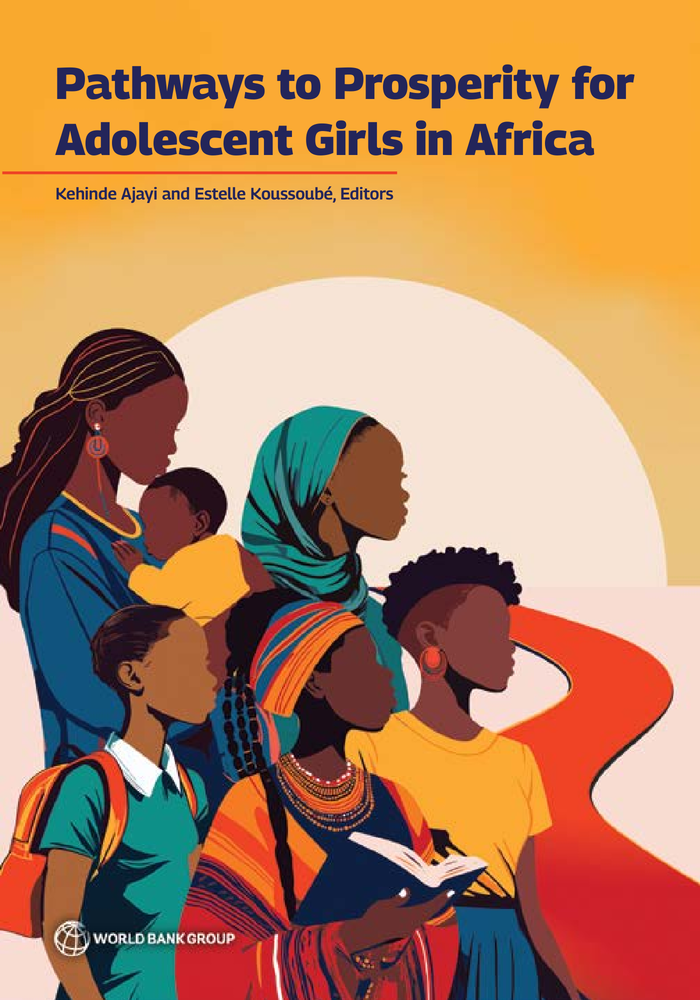
Cover of Ado Report
Pathways to Prosperity for Adolescent Girls in Africa
World Bank • Center for Global Development • Population Council · 2024

Africa stands at a crossroads, with its future prosperity hinging on the policy and investment decisions it makes today. The continent has an opportunity to shape the trajectories of generations to come by investing in the success of a pivotal population: its adolescent girls. With over 145 million adolescent girls calling Africa home, the potential for transformative change is immense. Yet challenges persist: from high rates of child marriage to limited educational opportunities. Over half of African girls ages 15 to 19 are out of school or married or have children. How can African countries overcome these challenges to ensure that adolescent girls enter adulthood empowered to thrive? Pathways to Prosperity for Adolescent Girls in Africa offers a groundbreaking roadmap for change. This landmark report outlines concrete, actionable policy recommendations; provides a comprehensive review of evidence-based interventions; presents a data-driven categorization of African countries to guide investments in adolescent girls; and introduces an innovative framework for understanding and measuring adolescent girls’ empowerment. Drawing on extensive research and consultations with adolescent girls, policymakers, and practitioners, the report reveals that investing in adolescent girls can yield a tenfold return in economic impact. It outlines six key areas for targeted action: building human capital, enhancing economic success, focusing on the most vulnerable girls, adopting a holistic approach, addressing data and evidence gaps, and mobilizing diverse stakeholders.
Cover of AfDD 2022
Africa's Development Dynamics: Regional Value Chains for a Sustainable Recovery
OECD • 2022

Africa’s Development Dynamics uses lessons from Central, East, North, Southern and West Africa to develop policy recommendations and share good practices. Drawing on the most recent statistics, the analysis of development dynamics aims to assist African leaders in reaching the targets of the African Union’s Agenda 2063 at all levels: continental, regional, national and local. The 2022 edition explores how developing regional value chains can help African countries rebound from the socio-economic shocks of the COVID-19 pandemic and accelerate productive transformation. It targets policy areas where private and public actors can support regional value chains when operationalising the African Continental Free Trade Area (AfCFTA). African firms can harness digital innovations to reduce production costs, and governments can design policies for skills development, public procurement and foreign investment to strengthen industrial linkages. Two continental chapters examine related African initiatives and global trends. Five chapters tailor policy recommendations to specific value chains in each region.

Cover of AfDD 2018
Africa's Development Dynamics: Growth, Job and Inequalities
OECD • 2018

This new annual report presents an Africa open to the world and towards the future. uses the lessons learned in the five African regions – Central, East, North, Southern and West Africa – to develop recommendations and share good practices. The report identifies innovative policies and offers practical policy recommendations, adapted to the specificities of African economies. Drawing on the most recent available statistics, this analysis of development dynamics aims to help African leaders reach the targets of the African Union’s Agenda 2063 at all levels: continental, regional, and national. Every year this report will focus on one strategic theme. This first edition explores the dynamics of growth, jobs, and inequalities. It proposes ten decisive actions to promote sustainable economic and social development and to strengthen institutions in Africa.